
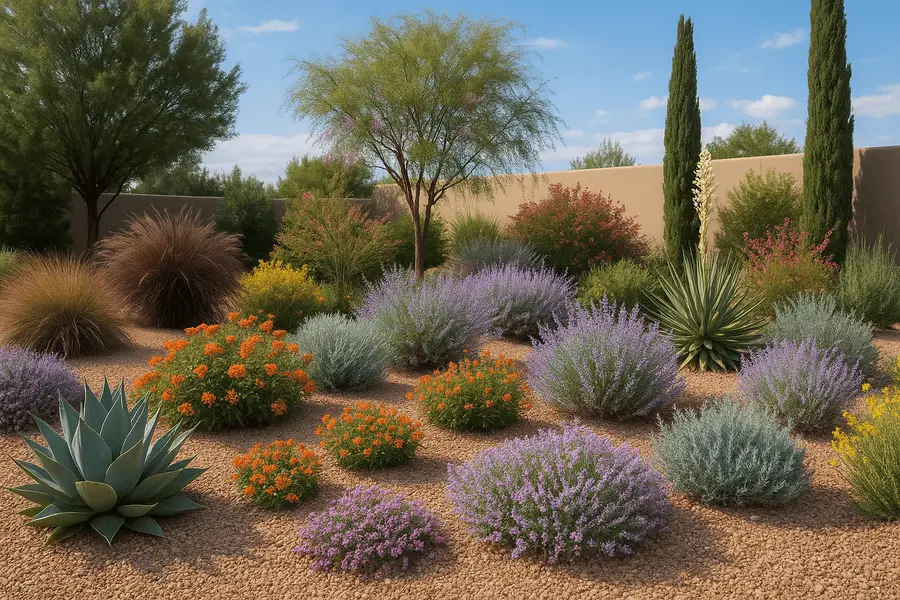
Finding the best xeriscaping plants for New Mexico starts with choosing plants that can handle heat, dry soil, and long stretches without rain. With much of the state dealing with desert or semi-arid conditions, water-wise landscaping makes far more sense than trying to maintain thirsty lawns.
The good news is New Mexico has plenty of drought-tolerant trees, shrubs, flowering plants, grasses, and succulents that thrive in these conditions. The right mix can create a landscape that saves water, supports pollinators, and stays beautiful through the seasons.
What You’ll Learn
- The best drought-tolerant plants for New Mexico landscapes
- How to choose trees, shrubs, and flowers for dry Southwest conditions
- Ways to build a water-wise yard with less maintenance
- Simple design tips to improve drought resilience and curb appeal
Quick Answer
The best xeriscaping plants for New Mexico include desert willow, red yucca, Apache plume, penstemon, agave, blue grama, lantana, and yarrow. These plants thrive in hot, dry climates while reducing irrigation and maintenance.
🌵 Best Xeriscaping Plants for New Mexico: Native Picks for a Water-Wise Garden
New Mexico’s climate can be tough on traditional landscapes, but it’s ideal for xeriscaping. By using drought-tolerant and native plants, you can build a yard that thrives with less water, less maintenance, and better resilience against heat and drought.
Below are some of the best plant choices for creating a practical and attractive xeriscape in New Mexico.
🌞 Why Xeriscaping Works in New Mexico
Gardening in New Mexico comes with its own set of challenges: intense heat, limited rainfall, and thirsty traditional lawns that just don’t make sense anymore.
That’s where xeriscaping steps in. It’s a practical, eco-friendly solution that fits the landscape and your lifestyle.
- 🌵 Naturally low rainfall and high summer heat
Xeriscaping embraces what the climate offers—plants that actually like it hot and dry. - 💧 Rising water costs and conservation needs
Less lawn and more drought-tolerant plants mean serious savings on your water bill. - 🐝 Supports native wildlife and pollinators
Native flowers and shrubs attract bees, butterflies, and birds to your yard. - 🏡 Reduces yard maintenance and improves curb appeal
You’ll spend less time mowing and more time enjoying a landscape that looks great year-round.
Ready to see what plants thrive in this kind of setup? Let’s start with the trees that give your yard structure, shade, and serious style.
🌳 Trees and Tall Structural Plants
Every great xeriscape starts with structure, and trees bring it in spades. These drought-tolerant picks offer shade, height, and sculptural beauty while standing strong in New Mexico’s dry heat.
- 🌸 Desert Willow (Chilopsis linearis)
Delicate, trumpet-shaped flowers bloom all summer, drawing in hummingbirds. It’s fast-growing and thrives with little water. - 🌲 Atlas Cedar (Cedrus atlantica)
This striking evergreen adds year-round height and drama. It’s slow-growing but worth the wait for its blue-green needles and elegant shape. - 🌿 Juniper (Juniperus spp.)
Tough as nails and perfect for dry slopes or rocky spots. Junipers come in all sizes and offer great coverage and privacy. - 🌲 Pinus (Pine Trees)
Several pines, like pinyon or ponderosa, do well in New Mexico. They’re hardy, low-water evergreens that bring woodland vibes to your yard. - 🌵 Italian Cypress (Cupressus sempervirens)
Tall and narrow with a bold silhouette, this Mediterranean favorite thrives in dry climates and adds instant sophistication.
Start your xeriscape from the top down with these resilient trees—they’ll anchor your design, cast cooling shade, and make your yard feel complete.
Up next: the best low-water shrubs to fill in the gaps with color and form.
🌺 Shrubs and Flowering Bushes
Looking for plants that bring color, texture, and structure—without the high-maintenance headache?
These drought-tolerant shrubs thrive in New Mexico’s climate and keep your garden interesting all year long.
- 🔴 Red Yucca (Hesperaloe parviflora)
Spiky, grass-like leaves and tall flower stalks with coral-red blooms. It’s a hummingbird magnet and thrives on neglect. - 💜 Russian Sage (Perovskia atriplicifolia)
Airy purple flowers and silvery stems make this shrub a real standout. It’s heat-loving, pollinator-friendly, and perfect for rocky spots. - 🌸 Cherry (Autumn) Sage (Salvia greggii)
This compact, evergreen shrub blooms from spring into fall with vibrant red, pink, or coral flowers. Easy, colorful, and a favorite of bees. - 🌾 Apache Plume (Fallugia paradoxa)
A native beauty with white flowers and fluffy, pink seed heads that resemble feathers. It adds texture and thrives with minimal water. - 🌈 Lantana (Lantana spp.)
Bursting with clusters of orange, yellow, red, or purple blooms. Lantana loves the heat and fills in space quickly with brilliant color.
Plant these hardy shrubs around patios, walkways, or as low hedges to create definition, color, and lasting appeal in your xeriscape.
Coming up next: the most vibrant perennials that keep blooming with barely a sip.
🌼 Native and Drought-Tolerant Perennials
These tough perennials don’t just survive the New Mexico sun they thrive in it.
With bold colors and reliable blooms, they bring life to your xeriscape without demanding much water or care.
- 🔴 Penstemon (Beardtongue)
Known for its tubular flowers and upright form, penstemon attracts hummingbirds and fits right in with desert-style gardens. - 💗 Showy Penstemon (Penstemon speciosus)
A standout among beardtongues with larger, vivid blue-purple blooms. It loves rocky soil and full sun. - 🔥 Indian Blanket (Gaillardia pulchella)
Bright red and yellow daisy-like flowers cover this native from spring through fall. It’s tough, colorful, and spreads easily. - 💜 Echinacea (Purple Coneflower)
This sun-loving favorite adds a soft, wildflower look while supporting bees and butterflies. It’s also known for being medicinal. - 🌻 Black-eyed Susan (Rudbeckia hirta)
Golden petals with dark centers bring that classic prairie look. They bloom for weeks and tolerate heat like pros. - 🌿 Yarrow (Achillea millefolium)
Fern-like foliage and flat-topped blooms make yarrow a pollinator-friendly and low-water powerhouse. - 🌸 Creeping Phlox (Phlox subulata)
A low-growing groundcover that blankets the soil in spring with soft pink or purple flowers. It’s great for erosion control too.
Mix these perennials throughout your beds to create layers of color, attract wildlife, and enjoy a landscape that keeps blooming no matter how hot it gets.
Ready for some ground-level beauty? Let’s look at top-performing groundcovers and vines.
🌿 Colorful and Hardy Groundcovers
Groundcovers are the quiet workhorses of a xeriscape. These low-growing plants help cover bare soil, reduce erosion, and add vibrant texture, all while thriving on very little water.
- ❄️ Delosperma (Ice Plant)
A sun-loving succulent that forms a low mat of bright, daisy-like blooms. It’s great for hot slopes, rock gardens, and curb appeal. - 🌱 Bugleweed (Ajuga reptans)
Ideal for part shade and slightly moister zones, this ground-hugger spreads with ease and shows off glossy foliage and purple flower spikes. - 🌸 Catmint (Nepeta spp.)
Though it grows a bit taller than classic groundcovers, catmint sprawls nicely and fills in garden edges with silvery leaves and lavender-blue flowers. - 🌼 Creeping Thyme (Thymus serpyllum)
A fragrant, walkable groundcover perfect for sunny paths and borders. It hugs the ground and produces tiny purple or pink blooms in spring and summer.
Let these tough and colorful spreaders do double duty—beautify your garden and protect your soil at the same time.
Next, let’s dig into the best drought-tolerant grasses for texture and movement.
🌾 Water-Wise Grasses for Texture and Movement
Ornamental and native grasses are the secret sauce for softening xeriscape edges and adding graceful motion to your yard.
They sway in the breeze, handle heat like champs, and look beautiful year-round, even when other plants take a break.
- 🌸 Pink Muhly Grass (Muhlenbergia capillaris)
A total showstopper in fall with clouds of feathery pink plumes. It’s drought-tolerant, low-maintenance, and adds major drama to borders or mass plantings. - 🌾 Switchgrass (Panicum virgatum)
A tall, upright grass with airy seed heads that catch the light. Native to the region, it’s tough, adaptable, and perfect for adding structure. - 💚 Blue Grama (Bouteloua gracilis)
A low-growing native with quirky, eyebrow-shaped seed heads. This grass is both charming and resilient—great for naturalized areas and pathways. - 🍃 Buffalograss (Bouteloua dactyloides)
This native turf alternative grows low, spreads wide, and needs very little water or mowing. Ideal for open, sunny spots. - 🎋 Fountain Grass (Pennisetum spp.)
Graceful and fast-growing with soft, arching plumes. Be sure to choose non-invasive varieties, and enjoy its movement and texture all season long.
Sprinkle these grasses throughout your landscape to soften stonework, frame planting beds, or fill larger areas with low-water style.
Up next: succulents and bold structure plants that thrive in the New Mexico heat.
🌵 Succulents and Desert Survivors
Looking for plants that laugh in the face of scorching sun and dry soil?
These bold beauties are built for survival and bring serious visual impact to any xeriscape, without the constant watering.
- 🌀 Agave (including Parry’s Agave)
Stunning rosette shapes with thick, pointed leaves make agave the star of any dry garden. Parry’s Agave is especially cold-hardy and perfect for New Mexico’s varied elevations. - 🪴 Sempervivum (Hens and Chicks)
Hardy and charming, these compact rosettes multiply over time and shrug off both freezing winters and dry summers. Ideal for rock gardens and containers. - 🌵 Cactus Varieties
From prickly pear to barrel cactus, these iconic desert dwellers come in all shapes and sizes. Most bloom in spring and summer and need almost no water once established. - 🌿 Stonecrop (Sedum spp.)
Low-growing, fleshy-leaved succulents that spread easily and bloom with starry flowers. Great for edging, rock crevices, or between stepping stones.
These architectural, low-water heroes are the backbone of a no-fuss xeriscape.
Let’s finish strong with some final tips to help your garden look great and stay that way, with minimal effort. Ready?
🛠️ Design Tips for a Thriving Xeriscape
Creating a beautiful water-wise garden in New Mexico isn’t just about picking the right plants. It’s about how you use them.
Smart design keeps your yard looking good, functioning well, and working with the desert climate, not against it.
- 🌞 Group plants by water and sun needs
Keep high and low water users together so you can irrigate efficiently without overwatering or stressing plants. - 🌿 Use mulch to retain moisture and block weeds
Organic mulch like bark or wood chips helps hold water in the soil and keeps pesky weeds from taking over. - 🪨 Incorporate gravel or stone paths for drainage and design
Hardscaping adds visual interest and improves runoff management while reducing the amount of space you need to irrigate. - 🌸 Plan for staggered bloom times for year-round color
Choose a mix of early, mid, and late-season bloomers so something’s always in flower—without extra effort. - 🐝 Use native plants to reduce care and attract pollinators
Native species are adapted to local conditions and help support bees, butterflies, and birds that thrive in your region.
Design with intention, and your xeriscape will be more than low-maintenance and it’ll be vibrant, functional, and full of life all year long. Want to wrap it up with a strong conclusion next?
Frequently Asked Questions
What are the best native xeriscape plants for New Mexico?
Some of the best native options include desert willow, Apache plume, blue grama, red yucca, and penstemon. These plants are adapted to New Mexico’s dry climate and support local wildlife.
Do xeriscape plants survive New Mexico winters?
Many do. Plants like juniper, agave, yarrow, and blue grama can handle both summer heat and winter cold, especially at higher elevations.
How often should xeriscape plants be watered in New Mexico?
Water deeply during the first growing season to establish roots. After that, many drought-tolerant plants need very little supplemental water.
Can I replace my lawn with xeriscape plants in New Mexico?
Yes. Many homeowners replace grass with drought-tolerant plants, gravel paths, and mulch to reduce water use and maintenance.
🌞Final Thoughts
Building a xeriscape in New Mexico is one of the smartest ways to work with the climate instead of against it. With the right drought-tolerant trees, shrubs, perennials, grasses, and succulents, you can create a landscape that uses less water and stays attractive year-round.
Start small, choose plants suited to your area, and build in layers. Over time, your xeriscape will become more resilient, easier to maintain, and better adapted to New Mexico’s dry conditions.
More Regional Xeriscape Plant Guides
References
New Mexico Xeric Guide – NM.Gov
Low Water Use/Drought Tolerant Plant List – Arizona Department of Water Resources
The Beginners Guide to Xeriscape in Denver – 5280 Magazine Denver’s Mile High Magazine
What is xeriscaping? A beginner’s guide to drought-tolerant landscaping – Colorado State University
UCCE Master Gardeners of San Joaquin County – Low Water Use Landscapes